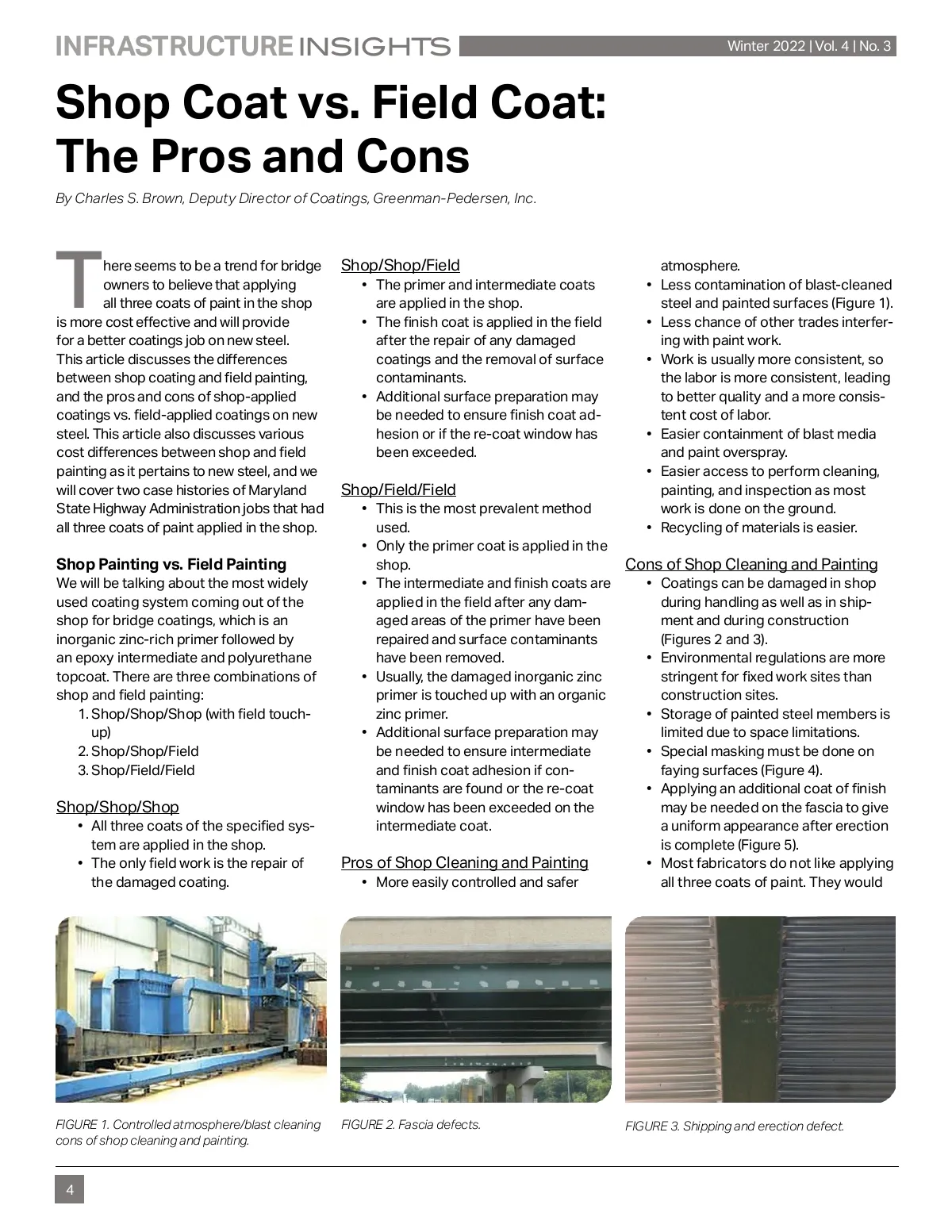
Winter 2022 | Vol. 4 | No. 3 rather apply zinc-rich primers and then ship it. INFRASTRUCTURE INSIGHTS Pros of Field Cleaning and Painting • Coating is not normally damaged during shipment. • No special handling or care tech-niques needed. • Zinc-rich primer coating damage during construction is easily repaired using an epoxy zinc coating with some minimal preparation work. • Finish coat is smooth and free of touchup marks. Two continuous full depth coats are being applied vs. touch up coats, feathering, etc. • Controlled environment may be ex-pensive on construction sites. • Less accessible. • Greater possibility for contamination of cleaned surfaces and uncured coatings. • May have conflicts with other trades. • Complex containment systems. FIGURE 4. Once the bolts were tightened on the surfaces, which had all three coats applied, failures occurred with the intermediate and topcoat fracturing down to the primer. This occurred on all bolted connections, including splice plates. Cons of Field Cleaning and Painting TABLE 1. Comparison of Field vs. Shop Costs Application of Paint (Location) Applying the primer coat in the shop (blast and prime) Cost Applying two coats of paint in the field (clean steel and apply two coats) $5/ft 2 $6/ft 2 $8/ft 2 $11/ft 2 Field Painting Costs (New Steel) Applying three coats of paint in the shop (blast and paint all three coats) On average, the cost for applying two coats of paint in the field ranges from $5 to $6 per square foot (1) and consists of cleaning the zinc primed steel, touching it up with an organic zinc primer, then applying a full coat of epoxy intermediate and a full coat of polyurethane finish. Also included are two stripe coats and access to the area, as well as all material costs. Work zone traffic control is usually provid -ed by the general contractor but may be done by the painting contractor on certain occasions. All costs cited in this article are pre-pandemic. (1) Apply the primer coat in the shop (blast and prime) and apply two coats of paint in the field (clean steel and apply two coats) applying a full coat of epoxy intermediate and a full coat of polyurethane finish. Therefore, the main cost difference between the shop and field painting of the intermediate and topcoats is that the cost for shop painting is $3 per square foot less, based solely on square footage estimates. However, we must consider the ar-eas that must be painted in the field on shop-coated steel, and this is where the price for all three coats of paint increases. We must factor in painting all the faying surfaces, bolt patterns, and fascia surfac-es, and touching up all the areas damaged during construction. This increases the cost of shop-coated steel. How much the cost increases will depend on damage during erection, the number of bolt pat-terns and diaphragms, and the condition of facias after construction. It has been this author’s experience that on all new steel jobs, all fascia surfaces get damaged during construction and will need to be cleaned and coated. On a typical job, the cost for this work ranges from $2.50 to $3 per square foot. When added to the overall cost, it worked out to be about the same as painting in the field, or more. However, more traffic control is needed to fix the damaged coat -ings, which can extend the job and cause it to be the same amount of time it would have taken to do all the painting in the field minus the primer. Shop Painting Costs Case Studies on Shop Painting All Three Coats on Two Maryland State Highway Administration Jobs Case 1 A comparison of field vs. shop coating costs is given in Table 1. On average, the cost for applying the primer coat in the shop is approximately $5 per square foot and consists of blast-cleaning the steel and applying a full coat of inorganic zinc primer. On average, the cost for applying all three coats of paint in the shop is ap-proximately $7 to $8 per square foot and consists of blast cleaning the steel and applying a full coat of inorganic zinc, then In March 2014, the Maryland State High-way Administration advertised a bid for the replacement of a dual bridge on I-70 over the Conococheague Creek. This contract required, among other things, to replace the existing structural steel for the bridge and called for all new steel to have all three coats of paint applied in the shop with inspection performed at the shop. Problems arose once the steel was shipped to the site as all the faying surfac-es (splice plates, diaphragm connections, 5
Infrastructure Insights Fall 2022: Page 5